


10 Best Preschool Classroom Seating Options for Schools

Choosing the right Preschool Classroom Seating involves more than matching bright colors to a room. Seating shapes movement, attention, independence, and teacher supervision. A low table can support cutting and drawing, while a soft floor cushion may encourage storytelling. A stable chair still matters during meals and group discussions.

The National Association for the Education of Young Children’s Developmentally Appropriate Practice position statement emphasizes responsive environments, active learning, and children’s varied developmental needs. The OECD’s Starting Strong research also connects high-quality early learning environments with meaningful interaction and participation. These findings suggest that schools should offer practical choices, not one fixed seat for every child. Small details matter. Rounded edges, washable surfaces, manageable weight, and suitable seat height can change a child’s daily experience.

This guide reviews 10 Preschool Classroom Seating options for schools, including stackable chairs, floor cushions, wobble stools, benches, soft seating, and flexible activity tables. The National Institute for Early Education Research’s State of Preschool Yearbook reports major differences in preschool funding, enrollment, and program quality across states. That variation makes purchasing decisions highly local. A rural classroom may need durable, easy-to-store furniture. A compact urban room may prioritize nesting seats and mobile tables. A cheerful cushion is not automatically a good seat. Some flexible products may also create noise, cleaning demands, or supervision concerns. Those weaknesses deserve attention. The best option balances comfort, safety, accessibility, durability, and classroom purpose. Teachers should test furniture with real routines before committing to a large order.
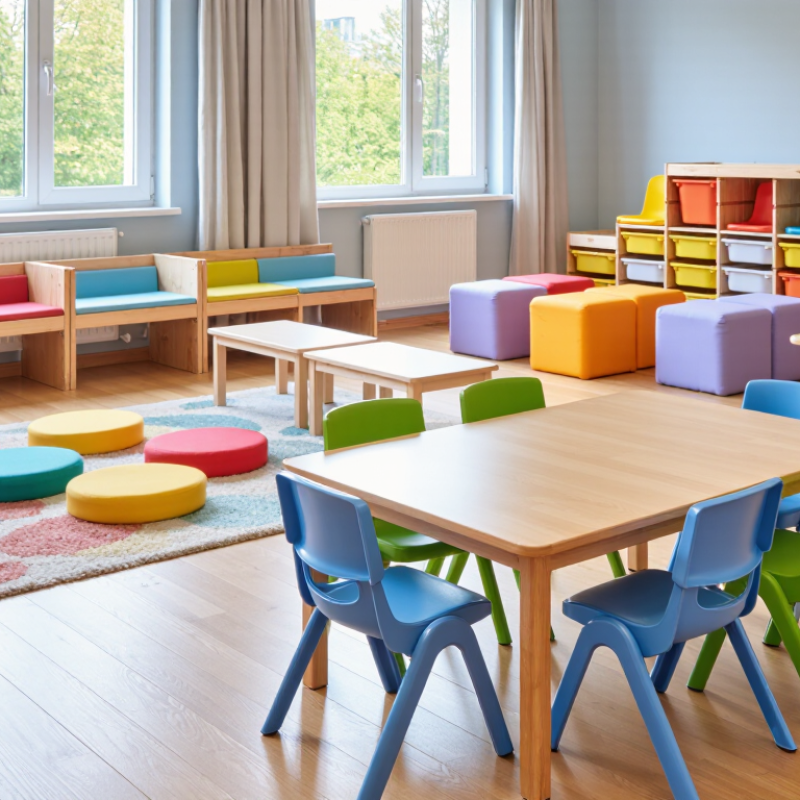
10 Best Preschool Classroom Seating Options for Schools

Preschool Seating Criteria: CPSC Safety Rules, ASTM Standards, and Fit Data

Choosing preschool seating requires more than colorful designs or a low price. Safety begins with current CPSC requirements, applicable recalls, and material rules under federal law. Check lead, phthalate, labeling, and entrapment risks where relevant. CPSC guidance may vary by product type, so schools should confirm details with qualified compliance professionals.

ASTM standards can support safer purchasing, but one standard may not cover every chair or stool. Look for testing against the relevant children’s seating specification, including stability, strength, sharp edges, and durability. Ask suppliers for test reports, not vague safety claims. Fit matters just as much. A child’s feet should rest flat, with knees near a right angle and thighs supported. Seat depth should avoid pressing behind the knees. Small details matter.

Measure children, not only age groups. A seat height that suits one four-year-old may strain another child’s posture. Adjustable tables can help, but they introduce pinch points and maintenance needs. Inspect fasteners, glides, cracks, and wobbling every day. A simple push test catches problems early. Avoid assuming that heavier furniture is automatically safer. It may still tip if the base is narrow. Classroom observation should guide final choices, because children shift, kneel, and sometimes lean back despite careful planning. No sizing chart replaces supervision or periodic review.


10 Best Options: Chairs, Benches, Floor Seats, and Flexible Learning Stations

10 Best Preschool Classroom Seating Options for Schools

10 Best Options: Chairs, Benches, Floor Seats, and Flexible Learning Stations

Preschool seating should support movement, independence, and short attention spans. The ten strongest options are child-sized chairs, stackable chairs, low benches, curved benches, floor cushions, carpet squares, wobble seats, soft stools, lap desks, and flexible learning stations. Each option serves a different moment. Chairs suit drawing tables. Benches support shared reading. Floor seats create a softer space for stories. Lap desks help children work away from fixed tables.

The Centers for Disease Control and Prevention recommends that children aged three to five remain physically active throughout the day. Seating should not quietly restrict that need. The Education Endowment Foundation reports that collaborative learning can produce an average gain of five months’ progress, although results depend on careful implementation. A semicircle of low benches may encourage conversation better than separate chairs. Still, too much flexibility can create noise and confusion. I have seen attractive layouts fail when children cannot identify their work zones.

Tips: Keep three seating heights available. Mark floor stations with simple visual cues. Choose rounded edges and stable bases. Test one flexible station before redesigning the entire room. Leave clear walking paths between tables. Observe posture, sharing, and transitions for two weeks. Some children may reject floor cushions. That is useful feedback, not a failure. Review the layout with teachers and caregivers, then adjust gradually.

10 Best Preschool Classroom Seating Options for Schools - 10 Best Options: Chairs, Benches, Floor Seats, and Flexible Learning Stations

Rank Seating Option Typical Dimensions Best For Recommended Age or Size Key Benefits Classroom Flexibility Cleaning and Storage Important Considerations
1 Ergonomic Preschool Chair Seat height: 10–14 in
Seat width: 10–13 in
Small-group instruction, meals, art, and writing activities Choose the seat height based on the child’s lower-leg length and table height Provides back support, stable posture, and a familiar sitting position Fixed seatingDaily use Lightweight models are easy to move; smooth plastic surfaces can usually be wiped clean Feet should rest comfortably on the floor, and the chair should fit safely under the classroom table
2 Stackable Classroom Chair Seat height: 10–14 in
Stacking height varies by design
Rooms that need quick reconfiguration or frequent floor-space changes Preschool and early elementary children, depending on seat height Can be stacked to save space and arranged quickly for different activities Highly movableSpace-saving Wipe-clean surfaces are practical; stacks should remain stable and within adult reach Do not create unstable stacks, block exits, or allow children to climb on stored chairs
3 Low Backless Bench Seat height: 10–14 in
Depth: approximately 10–14 in
Shared tables, group discussions, reading areas, and collaborative work Preschool children who can sit safely without individual back support Seats several children in a compact footprint and encourages side-by-side interaction CollaborativeCompact Easy to sweep beneath; sealed wood or plastic surfaces simplify routine cleaning Use a stable, non-tipping design with rounded edges and enough spacing for safe entry and exit
4 Padded Bench with Backrest Seat height: 11–14 in
Depth: approximately 12–16 in
Book corners, calm areas, dramatic-play spaces, and group listening Preschool children who benefit from added back support Offers comfortable shared seating and supports longer group activities Comfort-focusedGroup seating Removable, washable covers are preferable; inspect padding regularly for damage Soft furnishings should be kept away from blocked exits and supervised during active play
5 Floor Cushion or Carpet Square Approx. 12–20 in wide
Low-profile floor design
Circle time, storytelling, music, and quiet individual work Children who can transition safely between floor and standing positions Creates flexible personal spaces and supports a relaxed floor-based learning setting Very flexiblePortable Choose washable or wipeable materials; store cushions in a ventilated, accessible location Use non-slip backing where possible and leave clear walkways between seating spaces
6 Wobble or Active-Sitting Stool Seat height: commonly 10–16 in
Base should remain broad and stable
Short work periods, sensory variety, and movement-friendly learning stations Children able to control their body position and follow sitting expectations Allows limited movement while seated and can support engagement during brief tasks Movement-friendlyFlexible Lightweight stools are easy to relocate; clean non-porous surfaces after use Use selectively rather than for every activity; avoid designs that tip easily or encourage unsafe rocking
7 Floor Rocker or Low Rocking Seat Low seat profile
Width commonly 12–20 in
Reading, calming activities, sensory areas, and one-child learning spaces Children who can use rocking equipment with clear safety guidance Provides gentle movement and a defined personal space without requiring a full-size chair Sensory supportIndividual use Wipe-clean materials are preferred; inspect hinges, edges, and moving parts routinely Provide adequate clearance around the seat and supervise use to reduce tipping or collisions
8 Adjustable-Height Stool Adjustable seat height: approximately 12–18 in Multi-age classrooms, shared worktables, and changing learning stations Useful when children of different heights share one workspace Can match different table heights and support more than one classroom configuration AdjustableMulti-age Cleanable surfaces are practical; adjustment mechanisms require regular inspection Lock the height securely before use and select a wide, stable base appropriate for young children
9 Low Table with Integrated Seating Table height: commonly 18–22 in
Seat height: commonly 10–14 in
Construction play, puzzles, sensory activities, and cooperative projects Preschool children using low, accessible work surfaces Combines a defined work area with coordinated seating and reduces loose furniture Station-basedCollaborative Wipe table and seat surfaces daily; ensure the unit can be cleaned underneath Allow sufficient knee and foot space, and anchor or position the unit to prevent sliding
10 Standing Learning Station with Leaning Rail Work surface: commonly 20–24 in
Rail height should suit the children using it
Short art, sorting, sensory, and independent-choice activities Children who can stand and move safely with adult supervision Offers an alternative to sitting and supports brief changes in posture during learning Flexible stationPosture variety Open bases make sweeping easier; use durable, wipeable work surfaces Keep the station stable, avoid sharp corners, and provide enough space for children to move around it safely

Selection note: Dimensions are typical planning ranges rather than universal standards. Confirm local safety requirements, child measurements, table compatibility, supervision needs, and available floor space before purchasing or installing classroom seating.

Ergonomic Fit: Compare Seat Heights with the 10–14-Inch Child Range

Choosing preschool seating requires more than colorful shapes or stackable frames. Seat height directly affects posture, movement, and attention. For many young children, a 10–14-inch seat range offers a useful starting point. However, age alone cannot determine the correct fit. Measure from the floor to the back of the child’s knee while seated.

Feet should rest flat.

A well-fitted chair lets the child sit upright without lifting the shoulders. Knees should bend comfortably near a right angle, while the seat should support the thighs without pressing behind the knees. In classroom trials, teachers often notice better stability during drawing, puzzles, and shared reading when children can enter and leave seats independently. Low chairs, adjustable stools, floor cushions, and compact activity benches can all work, but each serves a different posture and movement need.

A practical review should compare every option against the 10–14-inch range, then test it with real children. Ergonomic assessment usually considers seat depth, foot support, desk height, and time spent sitting. I have seen classrooms choose attractive stools that were too tall for smaller children. That mistake encouraged leaning and dangling feet. One quick measurement is not enough. Children grow unevenly, and a room may need two or three seat heights. Recheck the fit during the school year, especially after desks, tables, or activity stations change.

Flexible Seating Evidence: Movement, Engagement, and Classroom Learning Data

10 Best Preschool Classroom Seating Options for Schools

Preschool seating should support movement without turning the room into a distraction. Options include child-sized chairs, floor cushions, low tables, carpet squares, wobble stools, and standing stations. Each choice serves a different need. A quiet child may participate more comfortably on a floor cushion. Another child may listen better while gently shifting on a stable stool.

Research on flexible seating shows promising links between movement, attention, and engagement. However, the evidence is not equally strong for every seating type. Some studies report more on-task behavior, while others find that novelty affects results. Teachers should collect simple classroom data instead of assuming flexible seating will solve attention challenges. Track participation during story time, task completion, transitions, and observed comfort over several weeks. Compare patterns across different seating arrangements.

Tips: Offer two or three choices at a time. Teach children how to move safely between spaces. Keep clear walking paths and check furniture stability daily. Use short observation notes, such as “stayed engaged for eight minutes” or “left seat repeatedly.” Our early observations may be messy. That is useful. Review them with teaching colleagues and adjust the layout gradually. A wobble stool might help during table work but create noise during group discussion. A floor area may encourage collaboration, yet some children may need defined personal space. The strongest classroom plan is responsive, measured, and willing to change.

School Buying Metrics: Cleanability, Space Efficiency, Cost, and Durability

10 Best Preschool Classroom Seating Options for Schools

School Buying Metrics: Cleanability, Space Efficiency, Cost, and Durability

Selecting preschool seating requires more than bright colors and small dimensions. Teachers need surfaces that tolerate paint, crumbs, spills, and frequent disinfecting. In purchasing reviews, nonporous molded chairs usually clean faster than fabric-covered seats. Smooth edges also reduce trapped dirt. However, very smooth plastic can become slippery when wet, so staff should inspect texture and stability before ordering.

A practical shortlist includes stackable molded chairs, nesting chairs, low stools, adjustable chairs, floor cushions, washable soft seats, classroom benches, chairs with arm supports, lightweight rocking seats, and modular cube seats. Stackable and nesting models protect floor space during cleaning or group activities. Low stools often cost less, but they may offer limited back support. Adjustable seating can serve children across several age groups. It sounds efficient. Yet moving parts may require more inspections.

Cost should include replacement parts, cleaning labor, storage needs, and expected service life. A cheap seat is not economical if cracks appear after one term. Look for reinforced joints, rounded frames, stable feet, and materials rated for frequent classroom use. Ask suppliers for cleaning instructions and weight guidance.

I once favored soft cushions because they felt welcoming, but their seams absorbed more mess than expected. That choice needed rethinking.

Schools should test a small sample for one week, record cleaning time, observe stacking behavior, and ask teachers whether children can sit safely without constant adjustment.

REQUEST FOR PORPOSAL

Bring the essence of Current to your space! Whether you envision a cozy coffee kiosk, a stylish window café, a dynamic coffee bar, or a multi-station coffee drive-through, the possibilities are endless.  Please fill out the form below to submit your proposal request. Our team will review your information and get back to you shortly.