2026 Top Solar PV Battery Types for Global Buyers
Solar Pv Battery selection is becoming a strategic decision for global buyers, not merely a price comparison. Solar installations are expanding rapidly, while grid congestion and evening demand increase the value of dependable storage. IRENA reported that solar power represented roughly three quarters of new renewable capacity added worldwide in 2023. The IEA also expects solar PV to remain the dominant source of renewable growth through 2030. More panels create more energy. They also create more curtailment risk.
Battery chemistry determines how that energy performs after sunset. BloombergNEF reported a sharp decline in average lithium-ion pack prices during 2024, supported by manufacturing scale and falling material costs. However, cheaper packs do not automatically deliver better project economics. LFP batteries usually provide strong thermal stability, long cycle life, and competitive pricing. NMC batteries can offer higher energy density, which matters where land or container space is limited. Sodium-ion systems are attracting attention, but their commercial track record remains less mature in many markets.
There is no universal winner.
This guide compares the leading Solar Pv Battery types for buyers evaluating utility, commercial, and residential projects in 2026. It considers usable capacity, round-trip efficiency, degradation, temperature behavior, safety systems, warranty language, and recycling pathways. The IEA’s Batteries and Secure Energy Transitions report highlights the growing importance of stationary storage for flexible electricity systems. Yet published specifications can hide practical weaknesses. A battery may perform well in a laboratory, but poor ventilation, weak monitoring, or unclear after-sales support can change the result. Buyers should verify field data, certification, local grid requirements, and supplier service records before signing contracts. Cost matters, but reliability often decides the final return.
Solar PV Battery Basics: Comparing Energy Density, Cycle Life, Efficiency, and Cost
2026 Top Solar PV Battery Types for Global Buyers
Solar PV batteries should be compared by more than purchase price. Lithium iron phosphate batteries usually offer strong thermal stability, high usable capacity, and long cycle life. Their energy density is lower than nickel-based lithium batteries, but this matters less in a fixed home or commercial cabinet. Typical lithium systems deliver 85–95% round-trip efficiency, while lead-acid systems often deliver about 70–85%. Flow batteries can support frequent cycling, yet their tanks and pumps require more space.
Cycle life changes the real cost. A battery used twice daily may need far more durability than one used during occasional outages. BloombergNEF reported an average lithium-ion pack price of 115 US dollars per kWh in 2024, down from previous years. However, stationary storage prices differ from vehicle packs. Lazard’s LCOS analysis also shows that utilization, project duration, financing, and replacement assumptions can reshape storage costs. The cheapest battery is not always the lowest-cost battery.
Tips: Check usable kWh, not the label capacity. Ask for cycle-life data at the intended depth of discharge and temperature. Include inverter losses, maintenance, recycling, and replacement costs. IEA analysis highlights the growing role of LFP chemistry, but market data remains imperfect. Local tariffs may matter more than a small efficiency gap. Test the assumptions.
2026 Top Solar PV Battery Types for Global Buyers
Solar PV Battery Basics: Comparing Energy Density, Cycle Life, Efficiency, and Cost
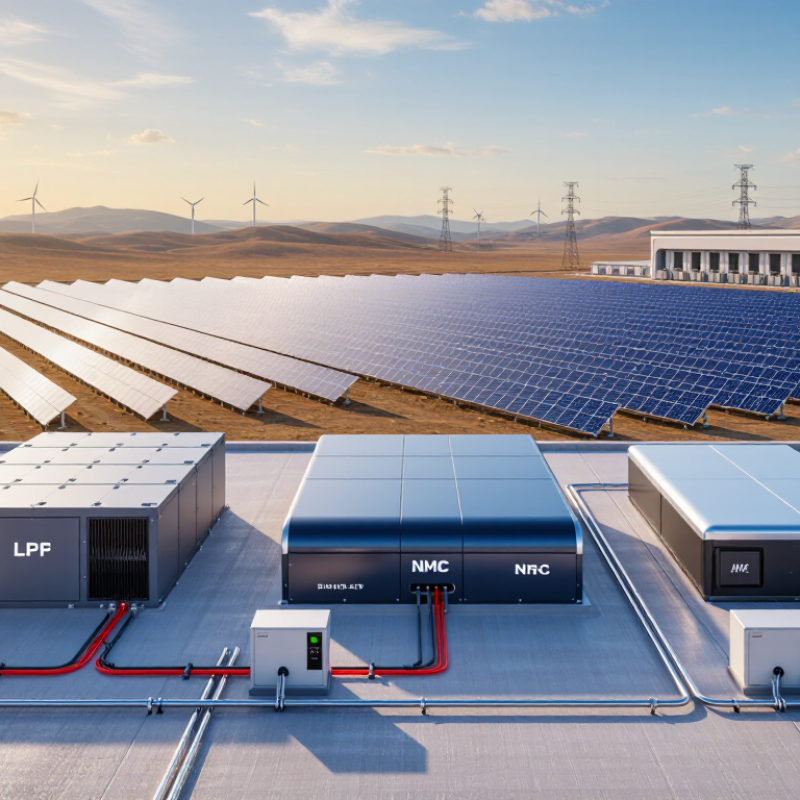
Lithium-ion NMC offers the highest energy density, while LFP generally provides the best balance of long cycle life, high round-trip efficiency, safety, and cost for stationary solar PV storage. Sodium-ion is an emerging option with competitive cycle life and cost potential, while lead-acid remains suitable mainly for low-cost, low-cycle applications. Values are representative midpoints from commonly reported industry ranges; actual performance and pricing vary by system design, temperature, warranty, installation, and market.
Lithium Iron Phosphate (LFP): 4,000–8,000 Cycles and 90–98% Round-Trip Efficiency
For global solar buyers, LFP batteries offer a strong balance between safety, durability, and cost. The chemistry commonly delivers 4,000–8,000 cycles under controlled conditions. At 80% depth of discharge, that may support more than ten years of daily operation. The IEA’s 2024 Batteries and Secure Energy Transitions report identifies LFP as a cost-competitive option for stationary storage. Its lower energy density can matter where installation space is limited.
Efficiency needs careful reading. A 90–98% round-trip figure usually describes optimized, DC-side performance. NREL’s 2024 Annual Technology Baseline models lower efficiency for complete AC-connected systems. Inverters, cables, cooling, and standby loads reduce delivered energy. Hot climates create another penalty. At 35°C, poor ventilation can accelerate degradation and trigger thermal derating. The headline number may mislead.
Tips: Ask for cycle-life data at the stated depth of discharge, temperature, and charge rate. Confirm whether efficiency means DC-to-DC or AC-to-AC performance. Compare warranty throughput, usable capacity, thermal limits, and replacement conditions. For remote projects, leave design margin for seasonal heat, cloudy weeks, and gradual capacity loss. Perfect assumptions rarely survive field operation.
Lead-Acid Batteries: 500–1,500 Cycles, 50% Recommended Depth of Discharge
Lead-acid batteries remain a practical option for some solar PV systems. They are familiar, widely serviceable, and often affordable for backup applications. A typical unit may provide 500–1,500 cycles under suitable operating conditions. The recommended depth of discharge is about 50%.
For example, a 200 Ah battery should normally supply roughly 100 Ah before recharging. This reserve reduces plate stress and supports longer service life. A 48-volt, 200 Ah bank stores about 9.6 kWh nominally, but only around 4.8 kWh should be routinely used. Inverter losses reduce the delivered energy further. Real-world results can be less tidy. That estimate is imperfect.
Temperature, charging quality, and daily load patterns strongly affect performance. A battery inside a hot, poorly ventilated cabinet may age faster than expected. Flooded units may need electrolyte checks and careful ventilation. Sealed units require less maintenance, but they still need correct charging settings. Installers should measure voltage, inspect terminals, and review the battery manufacturer’s technical limits.
Buyers should compare usable energy rather than advertised capacity alone. Frequent discharge beyond 50% can shorten the cycle count considerably. Heavy evening loads may expose this weakness quickly. Lead-acid systems also require more floor space and structural support than many newer alternatives. Ask for cycle-test conditions, temperature assumptions, warranty coverage, and recycling arrangements. Those details often reveal whether the quoted 1,500 cycles are realistic for the intended solar installation.
Sodium-Ion Batteries: 100–160 Wh/kg Energy Density for Emerging PV Storage
In 2026, sodium-ion batteries are gaining attention for emerging photovoltaic storage markets. Their energy density typically ranges from 100 to 160 Wh/kg. This is lower than many lithium-based systems. However, density is only one purchasing factor.
The chemistry uses more widely available sodium materials. This may reduce supply pressure and support steadier pricing over time. Sodium-ion cells can also perform reliably in colder environments, where some battery systems lose usable capacity.
For a rural PV installation, that matters. A cabinet exposed to winter nights needs suitable insulation, thermal monitoring, and a well-designed battery management system. Safety performance still depends on cell design, enclosure quality, installation, and testing.
Buyers should compare usable energy, not only rated capacity.
A 100 kWh system may deliver less after reserve limits, temperature effects, and conversion losses. Check cycle-life data under realistic charge rates. Ask for independent test reports, warranty conditions, fire protection details, and local certification. Field results can vary more than sales sheets suggest.
Sodium-ion technology is promising, but it is not automatically the best choice for every rooftop or utility project.
Larger cabinets may be necessary because of its lower energy density. That affects transport, foundations, and installation space.
A careful site study remains essential.
Global Buyer Selection: Matching Battery Chemistry to Climate, Scale, and LCOE
2026 Top Solar PV Battery Types for Global Buyers
Global Buyer Selection: Matching Battery Chemistry to Climate, Scale, and LCOE
For global solar buyers in 2026, battery selection starts with climate, not catalog rankings. Lithium iron phosphate (LFP) suits many utility and commercial projects because it combines strong cycle life with stable thermal behavior. In a 45°C container, however, every chemistry needs controlled ventilation, temperature monitoring, and conservative operating limits. Hot climates accelerate degradation when cooling is undersized. Cold regions create a different problem. Below freezing, charging may require heating or reduced power, which changes usable capacity and operating cost.
Nickel-rich lithium batteries can offer higher energy density where land or container space is expensive. Yet their thermal management demands and replacement assumptions deserve close scrutiny. Sodium-ion systems may become attractive for cost-sensitive, cooler applications, while flow batteries can fit long-duration storage with frequent daily cycling. The right comparison uses delivered LCOE, not cell price alone. Include round-trip efficiency, augmentation, fire protection, auxiliary loads, financing, and expected cycle count. A four-hour system may appear cheaper per kilowatt-hour than a two-hour system. Its project value still depends on tariff timing and grid constraints.
For small rooftop systems, compact LFP packs often simplify installation and maintenance. For remote solar plants, service access, spare modules, and recycling routes can outweigh a small efficiency advantage. I have seen models overvalue laboratory cycle data and undervalue dust, heat, and delayed maintenance. That shortcut fails in the field. Buyers should request tested performance at local temperature ranges, warranty assumptions, and degradation curves. Some forecasts will still be wrong. Use sensitivity cases for heatwaves, lower irradiation, delayed expansion, and electricity-price changes before approving procurement.