


7 Best Hotel Card Lock Systems for Global Buyers?

Choosing a Hotel Card Lock is not simply a matter of comparing prices. Global buyers must examine security, installation, software, maintenance, and guest experience together. A lock may look impressive in a showroom, yet fail during a power interruption or network outage. Real hotel conditions are less forgiving.

Hotel security consultant Michael J. O’Rourke notes, “The best lock is the one staff can trust during an ordinary busy night.” That practical view matters. Housekeepers need quick access. Front-desk teams need clear audit trails. Guests expect cards to work immediately, even with wet hands or crowded elevators. Reliable systems should support RFID cards, mobile credentials, emergency opening, and detailed access records. Battery warnings should appear before a guest finds a dark door.

This guide reviews seven Hotel Card Lock systems for international buyers. It considers installation flexibility, access technology, software integration, energy use, durability, and after-sales support. Some systems perform well in new construction. Others suit older properties with limited wiring. Neither option is automatically superior. Local technicians, replacement-card availability, language support, and regional certification can change the buying decision.

There is also room for doubt. Marketing claims often sound stronger than field results. A cheaper lock may create hidden costs through battery changes, software training, or repeated service calls. Buyers should request live demonstrations, sample hardware, warranty terms, and references from comparable hotels. The final choice should fit the property’s doors, staff habits, risk profile, and long-term operating budget. A perfect system does not exist. A dependable one can still protect trust, room access, and daily operations.
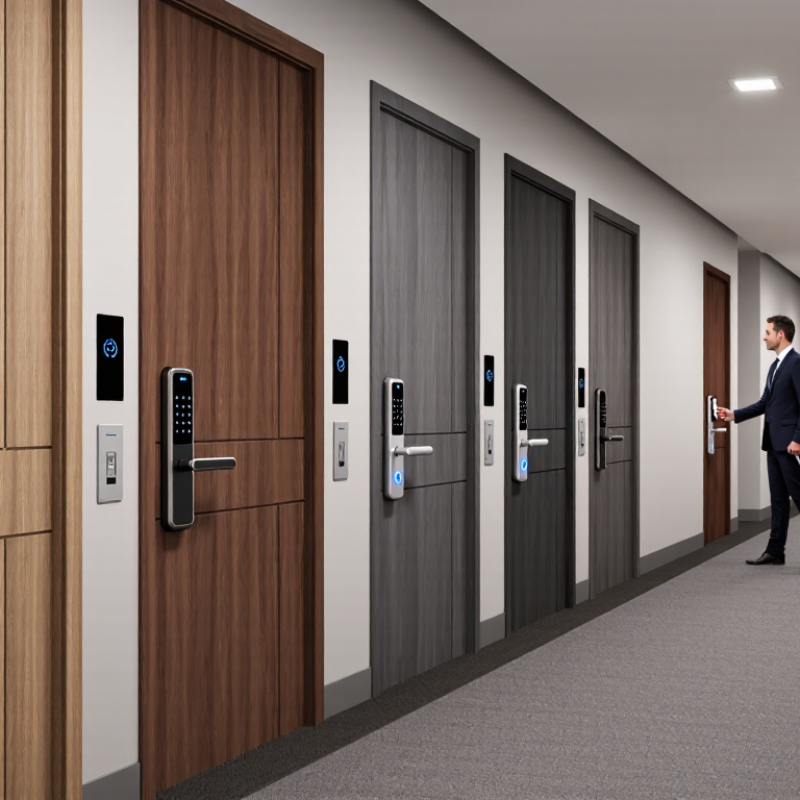
7 Best Hotel Card Lock Systems for Global Buyers?

Hotel Lock Fundamentals: Seven Card, Mobile, PIN, and Biometric Systems

Choosing among the seven best hotel card lock systems requires more than comparing prices. Global buyers should examine door compatibility, battery access, emergency opening, audit records, and maintenance support. In real hotel projects, a reliable lock must handle luggage carts, humid corridors, frequent guests, and rushed housekeeping staff. Seven common options deserve attention: magnetic-stripe cards, RFID cards, NFC cards, mobile credentials, PIN keypads, fingerprint readers, and facial-recognition terminals.

Magnetic-stripe cards remain simple and economical, but their strips can wear quickly. RFID cards offer stronger durability and convenient tap access. NFC cards work well with compatible smartphones and contactless workflows. Mobile credentials reduce plastic use, yet guests may face dead batteries, weak signals, or unfamiliar apps. PIN keypads suit short stays and staff areas, although shared codes weaken accountability. Fingerprint readers provide fast identity checks, but cleanliness and enrollment quality affect performance. Facial recognition can support hands-free entry, though lighting, privacy expectations, and data governance require careful review.

I would request a live demonstration before purchasing. Test a lock with wet hands, gloves, a nearly empty battery, and poor network coverage. Small details matter. Ask who controls access records and how long they remain stored. Confirm accessibility features and local safety requirements with qualified specialists. The most advanced option is not always the best option. A basic RFID system may outperform biometrics in a busy seaside hotel. I have seen buyers overlook replacement batteries and software training, then regret the decision. Procurement should include spare parts, installation guidance, and a realistic support response time.


RFID and NFC Locks: ISO/IEC 14443 at 13.56 MHz vs ISO/IEC 15693

For global hotel buyers, the strongest card lock options usually operate at 13.56 MHz. They commonly use ISO/IEC 14443 or ISO/IEC 15693 technology. These standards are not interchangeable in daily operation. ISO/IEC 14443 supports short-range proximity communication, often within a few centimeters. It is widely suited to tap-style entry and mobile credential designs. NFC applications generally align more closely with this short-range model.

ISO/IEC 15693 is designed for vicinity cards and can support a longer reading distance. That sounds convenient, but longer range may increase accidental reads near crowded doors. Lock designers must control antenna power, reader placement, and card orientation. A guest holding several cards can create an inconsistent experience. The faster response of many 14443 systems can also feel more natural at reception areas and guestroom doors. Still, performance depends on the reader, firmware, card security, and surrounding metal.

When comparing seven hotel lock systems, global buyers should verify supported card types, encryption methods, offline operation, audit records, battery warnings, and mobile compatibility. Ask for testing with local cards and smartphones. Not every “NFC-ready” lock supports every NFC credential. This wording is easy to misunderstand. During evaluation, test wet hands, tilted cards, thick wallets, and low batteries. Real doors are less forgiving than brochures. One practical concern is future replacement: a reader may accept 14443 cards today but lack a clear upgrade path for new digital credentials.

7 Best Hotel Card Lock Systems for Global Buyers? — RFID and NFC Locks: ISO/IEC 14443 at 13.56 MHz vs ISO/IEC 15693

System Type Credential Format RF Interface Typical Operating Distance Security Characteristics Mobile-Phone Support Online Capability Best-Fit Hotel Scenario
1. Secure RFID Card Lock ISO/IEC 14443 Contactless smart card 13.56 MHz Usually 1–5 cm at the lock, depending on antenna and card type Security depends on the chip and key-management scheme; encrypted credentials are preferable to fixed identifiers Limited unless the lock and credential platform support NFC mobile credentials Usually offline; audit data may be collected by a service device Standard guest rooms, resorts, and properties replacing magnetic-stripe cards
2. NFC Mobile-Ready Lock NFC ISO/IEC 14443-based card or phone credential 13.56 MHz Typically a few centimeters; the phone normally needs to be held close to the reader Can use secure app credentials, tokenization, and device security; the NFC frequency alone does not define encryption Yes, when the mobile platform, application, and lock reader are compatible Offline or connected, depending on the access-control architecture Business hotels, contactless check-in programs, and properties targeting reduced card issuance
3. Encrypted High-Security RFID Lock ISO/IEC 14443 Secure contactless smart card 13.56 MHz Approximately 1–5 cm in normal hotel-lock installations Supports stronger protection when paired with diversified keys, mutual authentication, encrypted communication, and credential lifecycle controls Possible if the selected credential technology supports NFC and the access platform is designed for mobile use Offline with event logging, or online through a gateway or wireless escutcheon Luxury hotels, high-occupancy properties, and sites requiring stronger protection against card cloning
4. ISO/IEC 15693 Long-Range RFID Lock ISO/IEC 15693 Vicinity smart card or tag 13.56 MHz The standard supports vicinity operation, but hotel locks commonly use a much shorter practical range of about 2–10 cm Security varies by chip family and implementation; ISO/IEC 15693 specifies the air interface, not a complete hotel security policy Generally limited compared with NFC-oriented ISO/IEC 14443 credentials Most commonly offline; connected versions require additional networking hardware Facilities using existing ISO/IEC 15693 badges or applications needing convenient card presentation
5. Dual-Technology RFID/NFC Lock ISO/IEC 14443 ISO/IEC 15693 Dual-frequency-compatible credential support 13.56 MHz Usually 1–5 cm for hotel-room operation; actual performance depends on the reader design and credential Allows migration between credential types, but each credential still requires appropriate authentication and key management Available when the 14443/NFC side and mobile software are supported Offline, online, or hybrid depending on the lock controller Global hotel groups, mixed-inventory properties, and phased technology upgrades
6. Wireless Online RFID Lock ISO/IEC 14443 Contactless card or NFC credential 13.56 MHz plus Wi-Fi, BLE, or proprietary wireless backhaul Card or phone is normally presented within a few centimeters; network range is determined by the backhaul Combines credential authentication with real-time policy updates, remote revocation, and event reporting when connected Often available, subject to mobile credential and reader compatibility Yes; real-time operation depends on network availability and power design Large hotels, multi-building resorts, and operations requiring remote monitoring
7. Hybrid RFID + PIN or Mechanical Override Lock ISO/IEC 14443 RFID/NFC credential with PIN or emergency key backup 13.56 MHz, with optional keypad or mechanical cylinder RF credential presentation is typically within 1–5 cm Provides operational redundancy; PIN policies, override-key control, audit logging, and credential security should be managed separately Possible through NFC mobile credentials when supported by the reader and software Usually offline; hybrid online models are also available Remote lodging, serviced apartments, staff areas, and properties needing multiple access methods

Technical note: ISO/IEC 14443 and ISO/IEC 15693 define contactless card or tag communication characteristics at 13.56 MHz; they do not by themselves guarantee a specific security level, read distance, mobile-phone function, or hotel access-control workflow. Actual performance depends on the reader, credential chip, antenna, door hardware, software, and installation environment.

Magstripe, BLE, QR, and PIN Locks: ISO/IEC 7811 and Bluetooth SIG Data

Choosing among the seven best hotel card lock systems requires more than comparing prices. Magstripe locks remain practical for older properties because ISO/IEC 7811 defines essential magnetic stripe data formats. However, cards can wear after repeated use, especially near humid beach entrances. BLE locks use Bluetooth Low Energy and support mobile credentials, audit records, and remote updates. Their reliability depends on proper signal planning and secure device pairing.

QR locks reduce physical card handling. Guests scan a time-limited code, but poor lighting, cracked screens, or weak network access can create delays. PIN locks are simple for serviced apartments and backup entrances. They need shielded keypads, regular code changes, and clear failed-entry controls. BLE systems may offer better convenience, yet they require stronger battery monitoring and staff training. That trade-off is easy to underestimate.

Tips: Ask suppliers for ISO/IEC 7811 compatibility evidence, Bluetooth SIG qualification details, battery test results, and offline operating procedures. Test every lock with wet hands, low phone battery, damaged cards, and crowded corridors. Do not rely only on a showroom demonstration. A QR reader that works perfectly indoors may struggle beside a bright window. PIN systems can also seem secure until staff reuse one code for months. Trial results, maintenance records, and documented access permissions provide more dependable evidence than impressive feature lists.

Security Benchmarks: UL 294, ANSI/BHMA A156.25, EN 14846, and GDPR

7 Best Hotel Card Lock Systems for Global Buyers?

Security Benchmarks: UL 294, ANSI/BHMA A156.25, EN 14846, and GDPR

A strong hotel card lock begins with the right security benchmark. UL 294 evaluates access control system performance, construction, and safety. Its listing scope matters. A component may pass without covering the complete door assembly. Check the exact model, reader, controller, and power configuration. Do not rely on a certificate headline alone.

ANSI/BHMA A156.25 addresses electromechanical locks and testing details. It helps buyers compare durability, cycling performance, and operational reliability. EN 14846 serves a similar role for electromechanically operated locks in European markets. These standards are not interchangeable. Regional installation rules still apply. Ask for current test reports, not only marketing claims.

GDPR changes the question from “Can this lock open?” to “What data does it retain?” Card IDs, room assignments, entry times, and staff records can identify people. Configure short retention periods. Limit administrator access. Encrypt stored and transferred records when supported. Keep audit logs readable.

A practical hotel evaluation should include a busy corridor test. Test weak batteries, emergency power, offline operation, and repeated card use. Check whether the latch releases smoothly after dust exposure. Small failures become expensive at midnight.

No checklist is perfect. A compliant lock can still be poorly installed. Train staff, document maintenance, and review permissions regularly. Seven systems may appear similar, but their evidence quality often differs sharply.

Global Buyer Scorecard: Battery Life, Read Range, Offline Logs, and 5-Year TCO

7 Best Hotel Card Lock Systems for Global Buyers?

Global buyers need more than a polished product sheet. A practical scorecard compares battery life, read range, offline logs, and five-year total cost of ownership. Battery claims should reflect daily hotel use, not laboratory standby time. Test locks on busy doors with repeated guest entry, housekeeping access, and low-temperature storage. Record battery changes by room and month. Field conditions matter.

Read range often changes with card angle, reader placement, metal doors, and crowded corridors. Measure successful reads at several distances, then repeat the test with worn cards. A reliable system should also retain offline access events when the network fails. Check timestamp accuracy, storage capacity, export options, and protection against unauthorized viewing. Some systems store fewer events than buyers expect.

Five-year TCO should include locks, cards, batteries, installation labor, software fees, training, repairs, and replacement shipping. Local service costs can outweigh the initial purchase price. Use a room-by-room spreadsheet with regional currency and realistic maintenance rates. A credible review should document test conditions and separate measured results from supplier claims. No scorecard is perfect. Battery performance may vary across climates, and read-range testing can miss unusual guest behavior. That uncertainty deserves a visible note, not a hidden footnote.

REQUEST FOR PORPOSAL

Bring the essence of Current to your space! Whether you envision a cozy coffee kiosk, a stylish window café, a dynamic coffee bar, or a multi-station coffee drive-through, the possibilities are endless.  Please fill out the form below to submit your proposal request. Our team will review your information and get back to you shortly.