


China Top 10 Industrial Managed PoE Switch Manufacturers?

An Industrial Managed Poe Switch does more than connect devices. It delivers power and data across factory networks, while giving operators tools to monitor traffic, separate network segments, and respond to faults. On Ethernet’s broader role, co-inventor Bob Metcalfe has called it “the plumbing of the Internet.” That image fits industrial networks: cables and switches may be out of sight, but a weak link can stop a camera, access point, or control device from communicating. Small details matter.

Choosing a manufacturer takes more than comparing port counts. Buyers should examine operating-temperature ratings, enclosure options, surge protection, power budgets, redundancy features, management interfaces, and documented test results. A dusty cabinet beside a production line is not a quiet office environment. Nor does a long list of features prove reliability. Ask how products are tested, what support is available, and whether specifications match the intended site. Those questions can expose gaps that a polished brochure might hide.

This overview of China’s top 10 manufacturers is a starting point, not a universal ranking. Product lines and capabilities change, and supplier claims deserve independent review. Some comparisons will remain imperfect. That is worth admitting. The most suitable choice depends on the devices, installation conditions, maintenance skills, and network design at each facility. Use the list to narrow the field, then verify current datasheets and service terms before making a decision.
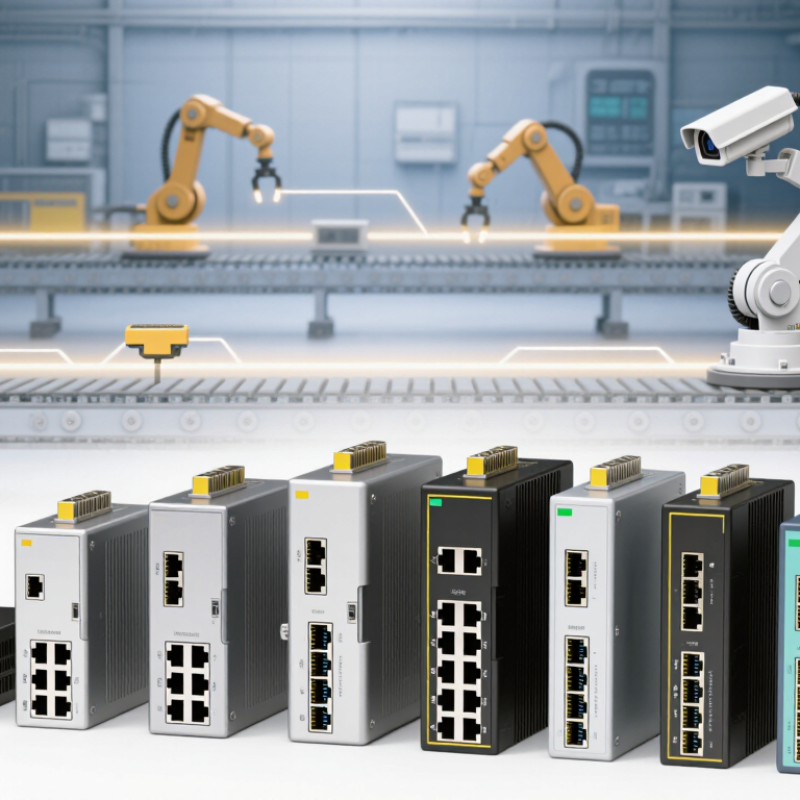
China Top 10 Industrial Managed PoE Switch Manufacturers?

Industrial Managed PoE Switches: Functions and Key Specifications

Industrial managed PoE switches combine Ethernet connectivity with power delivery for cameras, wireless access points, and sensors. They can reduce separate power cabling in control cabinets and across factory floors. Useful management features include VLANs, QoS, port mirroring, and SNMP monitoring. These help operators separate traffic, prioritize time-sensitive data, and diagnose faults remotely. Keep it practical.

Port capacity matters, but total PoE budget matters just as much. IEEE 802.3af, 802.3at, and 802.3bt support different power levels, while cable length and device demand affect what reaches an endpoint. Check both the per-port limit and the switch’s overall budget. A unit with many PoE ports may not power every device at full load. That detail is easy to miss.

For harsh environments, review the specified operating temperature, shock and vibration ratings, and mounting method, such as DIN rail. Dual DC inputs can improve power resilience, while ring redundancy can help restore connectivity after a link failure. Confirm the recovery behavior rather than relying on a protocol name alone. Security features such as access controls, HTTPS, and event logs also deserve attention. A spec sheet can look perfect; real wiring conditions still surprise you.


Criteria for Evaluating Chinese Industrial PoE Switch Manufacturers

Choosing an industrial PoE switch manufacturer is less about port count than evidence of performance under real operating conditions. Grand View Research estimated the broader industrial Ethernet market at USD 10.2 billion in 2023, projecting a 7.5% compound annual growth rate through 2030. Growth alone does not prove product quality. Ask for test reports covering operating temperature, vibration, electromagnetic interference, and power-load behavior. Check whether the published PoE budget remains available at high temperatures, not only in a cool laboratory. IEEE 802.3bt defines up to 90 watts at the power-sourcing equipment, but cable length and heat affect power delivered to devices. Small details matter.

Assess the manufacturer’s engineering transparency, too. Request clear specifications for surge protection, redundant power inputs, alarm outputs, and recovery after a network-ring fault. Verify that the switch can supply cameras or access points simultaneously, without exceeding its thermal or total-power limits. Ask how firmware updates, spare parts, and technical support are handled over the equipment’s service life. A polished datasheet is not field evidence. A pilot test in the intended cabinet can reveal overheating, connector strain, or confusing diagnostics before deployment. I would also question vague claims such as “industrial-grade” when no test conditions are stated. That is easy to overlook. Compare documented results, not adjectives.

Profiles of 10 Leading Chinese Industrial Managed PoE Switch Manufacturers

The ten manufacturer profiles should be read as a practical comparison, not a simple ranking. Each company’s strengths may differ across switching capacity, ruggedness, and support for network management. Industrial managed PoE switches commonly serve cameras, access points, and sensors in factories, road cabinets, and utility sites. Real conditions matter. Heat, vibration, dust, and unstable power can expose weaknesses that a product sheet may not show.

A useful profile checks port counts, PoE budgets, uplink options, and management functions such as VLANs, ring protection, and traffic monitoring. It should also examine operating-temperature ratings, enclosure design, power-input range, and available test documentation. For example, a cabinet powering several cameras needs enough PoE capacity after accounting for startup loads, not merely a high advertised port count. Ask how firmware updates and replacement units are handled. Details like these are easy to overlook.

The ten profiles can help buyers compare manufacturers by engineering focus, production consistency, customization, and after-sales responsiveness. Some may suit compact edge installations; others may offer broader port configurations or stronger environmental specifications. Evidence matters more than polished claims: request test reports, confirm the exact model revision, and check whether stated features are included or optional. Even careful comparisons have limits. Product lines change, and public information may not reveal long-term field performance.

Comparison of Product Features, Certifications, and Support

China’s industrial managed PoE switch suppliers should be compared by power budget, port speed, redundancy, and environmental tolerance—not port count alone. Check whether models support IEEE 802.3af, 802.3at, or 802.3bt, and confirm the total PoE budget under full load. A switch powering cameras and access points may need more headroom than its datasheet’s per-port figure suggests. Look for dual power inputs, ring recovery, VLAN controls, and operating-temperature ratings suited to the cabinet location.

Certifications should match the installation. IEC 61000-6-2 addresses industrial immunity; IEC 61850-3 is relevant to power utility environments. Neither replaces checking the exact model’s test documentation. HMS Networks’ 2024 Industrial Network Market Shares report estimates industrial Ethernet at 71% of newly installed factory-automation nodes, reinforcing the need to assess protocol compatibility and network diagnostics. Compare warranty terms, firmware-update policies, response times, and access to configuration support. A polished datasheet is useful, but it cannot reveal every field issue.

Tips: Request certification documents for the exact model and ask for a sample configuration. Check PoE performance at your expected ambient temperature. Small detail, big difference. Support quality can vary by region, and published response targets do not always reflect real repair times.

China Top 10 Industrial Managed PoE Switch Manufacturers? - Comparison of Product Features, Certifications, and Support

An anonymized comparison framework. Since no verified manufacturer or model data was provided, supplier-specific specifications, certifications, rankings, and support commitments are not attributed or assumed.

Supplier Profile Managed Features to Compare PoE Details to Verify Industrial Hardware Details to Verify Certifications and Compliance Support and Warranty
Manufacturer 01 Confirm VLAN, QoS, port mirroring, SNMP, and web/CLI management on the quoted model. Check IEEE 802.3af/at/bt support, per-port limits, and total PoE budget on the datasheet. Verify operating-temperature range, mounting options, input-voltage range, and relay/alarm features. Request model-specific certificates and test reports; do not infer certification from the product category. Confirm service hours, response targets, firmware updates, warranty term, and return procedure in writing.
Manufacturer 02 Ask whether the exact model supports the required VLAN, redundancy, access-control, and monitoring functions. Verify PoE standard, available power budget, power allocation behavior, and overload protection. Check temperature rating, enclosure/IP rating if applicable, DIN-rail options, and power-input redundancy. Request the certificate number, issuing body, covered model, and validity details. Check local technical support availability, documentation language, firmware policy, and warranty exclusions.
Manufacturer 03 Confirm management interfaces, supported network protocols, configuration backup, and event logging. Check which ports provide PoE, supported IEEE standard, maximum output, and total switch budget. Verify vibration and shock specifications, surge protection details, and permitted installation environment. Request compliance documents for the specific SKU and the destination market. Confirm escalation path, remote troubleshooting options, spare-unit availability, and repair process.
Manufacturer 04 Verify L2/L3 capabilities against the application; feature names alone do not establish implementation details. Check PoE scheduling, monitoring, restart controls, and power budget under the intended temperature range. Review operating-temperature limits, redundant power inputs, grounding guidance, and installation clearances. Validate any claimed CE, FCC, UL, or other approval against official documentation for the model. Ask for published warranty terms, firmware download access, and the lifecycle/end-of-support policy.
Manufacturer 05 Test required functions such as VLAN tagging, QoS, RSTP/MSTP, and SNMP in a proof-of-concept. Match PoE standards and total wattage to the powered devices; confirm cable and distance requirements. Request datasheet values for temperature, humidity, mounting, and electrical protection. Check that reports identify the relevant model and applicable standard or regulation. Confirm support channels, response-time commitments, RMA shipping responsibility, and repair turnaround.
Manufacturer 06 Confirm supported management access, authentication options, firmware maintenance, and configuration restore. Verify port-level PoE control, power prioritization, per-port limits, and total available PoE power. Check redundant power and alarm contacts where required; verify each feature in the model documentation. Request current, traceable certificates or declarations; verify scope and market applicability. Ask whether technical support and firmware updates remain available throughout the expected deployment life.
Manufacturer 07 Confirm compatibility with the network’s management platform, monitoring protocols, and configuration workflow. Check IEEE PoE compatibility and actual power availability for the planned number of connected devices. Verify temperature derating, power-input tolerance, mounting type, and any stated environmental ratings. Obtain model-specific compliance evidence rather than relying on general company-level claims. Confirm documentation quality, language availability, escalation contacts, and warranty coverage by region.
Manufacturer 08 Evaluate required switching, redundancy, access-control, and monitoring features using the exact firmware version. Review the PoE budget table and operating limits; confirm behavior when the total budget is exceeded. Request test conditions and limits for temperature, electrical protection, and industrial installation. Check the named product family, model variant, and manufacturing configuration on each document. Confirm firmware notification process, security-fix policy, replacement availability, and RMA terms.
Manufacturer 09 Verify that management features are included in the offered hardware and software configuration. Confirm supported PoE standards, powered-port count, per-port output, and total budget at the rated conditions. Check enclosure, mounting, ambient-temperature rating, and power-supply requirements in the datasheet. Request declarations and certificates applicable to the intended country and installation. Ask for written warranty duration, support hours, service response targets, and firmware access conditions.
Manufacturer 10 Use a feature checklist and hands-on validation to compare management functions consistently. Verify PoE interoperability with the target devices and confirm power margin for startup and peak load. Confirm environmental ratings, redundancy, alarms, and protection features for the deployment site. Independently verify all claimed approvals using the relevant certificate or regulator database. Compare support coverage, firmware lifecycle, spare parts, warranty, and escalation commitments.

Note: IEEE 802.3af, 802.3at, and 802.3bt specify different PoE power capabilities. Actual power available to a device depends on the switch model, port limits, total power budget, cabling, and operating conditions. Confirm all specifications against the exact product datasheet and written supplier documentation before purchase.

How to Choose a Manufacturer for Your Network Requirements

Choosing an industrial managed PoE switch manufacturer starts with your actual network conditions, not a product list. Count the cameras, access points, and sensors, then calculate their peak power needs. Leave headroom for future devices. Check operating temperature, vibration resistance, mounting options, and the switch’s total PoE budget. A unit that works in a cool office may struggle inside a crowded cabinet near production equipment.

Tips: Ask for clear power-budget tables, temperature ratings, and test reports. Confirm support for VLANs, QoS, redundancy, and remote monitoring if your network needs them. Request a sample configuration or a practical demonstration. Small details matter.

Evaluate the manufacturer’s engineering support, documentation, warranty terms, and ability to provide consistent specifications across product batches. Ask how firmware updates are handled and what diagnostic information is available when a port fails. In real installations, cabling quality and ambient heat can affect performance as much as switch specifications. Heat changes everything. Be cautious of vague claims such as “industrial grade” without test conditions. One limitation: a datasheet cannot predict every site issue, so verify critical requirements with a pilot installation before ordering at scale.

REQUEST FOR PORPOSAL

Bring the essence of Current to your space! Whether you envision a cozy coffee kiosk, a stylish window café, a dynamic coffee bar, or a multi-station coffee drive-through, the possibilities are endless.  Please fill out the form below to submit your proposal request. Our team will review your information and get back to you shortly.