


Who Are the Top Shoulder Press Machine Suppliers in China?
Choosing a Shoulder Press Machine for a commercial gym takes more than comparing prices or polished product photos. Buyers need to inspect the details that shape daily use: the seat’s adjustment range, the handle’s starting position, the smoothness of the press, and the stability of the frame under load. Supplier quality matters just as much. Ask for clear specifications, realistic production timelines, warranty terms, and evidence of quality checks. Request a demonstration or sample evaluation when practical. A brochure cannot reveal every rough edge.
Exercise scientist Brad Schoenfeld’s research examines how resistance training supports muscle growth. A useful principle drawn from that work is: “Evaluate the machine by the quality of controlled resistance it allows, not by appearance alone.” This is a practical summary, not a verified direct quotation from Schoenfeld. It also points to a limitation: a well-built machine cannot compensate for poor fit or unclear adjustments.
This overview compares leading Chinese suppliers through concrete purchasing criteria, including product range, customization, manufacturing capability, communication, and after-sales support. It aims to help gym operators and distributors ask sharper questions before requesting quotations. Supplier claims still require verification. Check documents, inspect samples where possible, and confirm that the delivered model matches the agreed specifications. Some comparisons may remain imperfect because public information is uneven. That uncertainty should be stated, not hidden.
What Is a Shoulder Press Machine and How Is It Used?
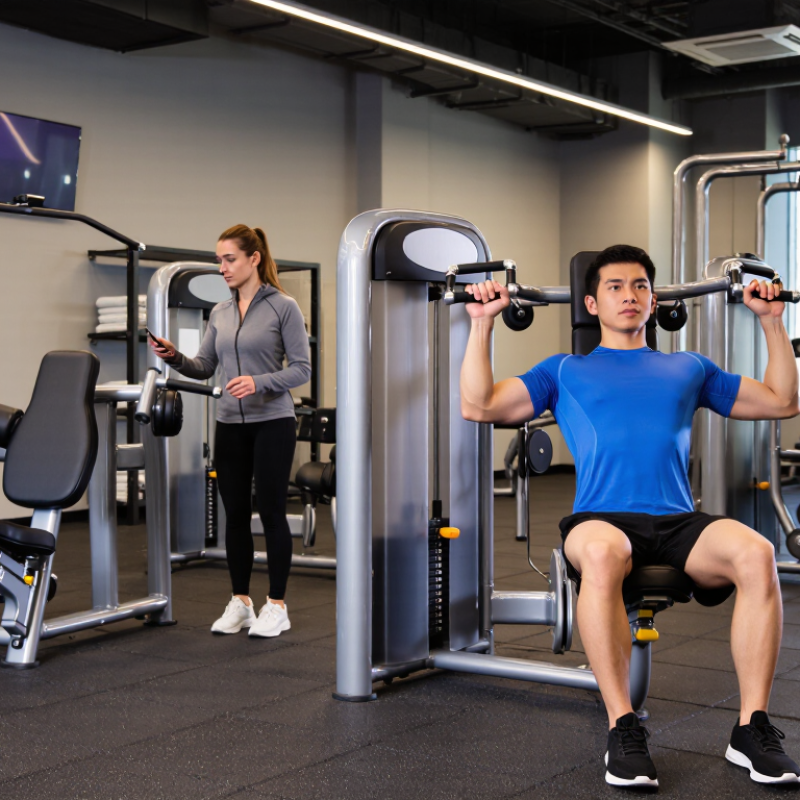
A shoulder press machine is a strength-training station that guides an overhead pushing movement. It mainly works the shoulders, especially the deltoids, while the triceps assist. Depending on the machine’s design, the seat, handles, and range of motion may differ. The guided path can help beginners practise steadily, but it does not make poor positioning harmless.
Adjust the seat so the handles begin around shoulder height. Sit with your back supported and feet flat on the floor. Grip the handles firmly, then press upward without locking your elbows. Lower the weight slowly until your hands return near shoulder level. Keep your wrists straight and avoid arching your lower back. Start light. I would not assume one setup fits everyone; shoulder comfort and arm length can change how the movement feels. Stop if you feel sharp pain, and ask a qualified trainer to check your form when unsure.
Tips: Use a load you can control for every repetition. Breathe out as you press and breathe in as you lower. Check that the seat and weight selector are secure before starting. Small adjustments matter, and rushing them is an easy mistake.
Who Are the Top Shoulder Press Machine Suppliers in China? - What Is a Shoulder Press Machine and How Is It Used?
| Topic | Information | What to Check |
|---|---|---|
| What the machine is | A resistance-training machine designed to guide an upward pressing movement from around shoulder level. | Confirm the machine’s movement path, handle position, and intended user range. |
| Main muscles used | The deltoids and triceps are primary contributors; the upper chest and other shoulder-girdle muscles may assist, depending on the machine and technique. | Check that the machine’s instructions describe the exercise and setup accurately. |
| How it is used | Adjust the seat, take hold of the handles, and press upward under control. Return the handles smoothly to the starting position without bouncing or forcing the shoulders into an uncomfortable range. | Look for clear adjustment labels and accessible instructions. Users should follow the equipment manual and stop if they feel pain. |
| Common machine formats | Selectorized models use a weight stack and pin; plate-loaded models use weight plates. Designs may have fixed or independently moving arms. | Verify the resistance type, included components, loading method, and whether the arms move together or separately. |
| Seat and handle adjustment | Seat adjustment helps users position the handles near shoulder level at the start of the exercise. Handle design and spacing affect grip and comfort. | Request adjustment ranges, dimensions, grip details, and fit information for the intended user population. |
| Supplier comparison in China | There is no single objective “top supplier” ranking without defined criteria and independently verified, comparable data. | Compare suppliers using the same written specification, sample evaluation, documentation, and service requirements. |
| Product specification | Relevant details include overall dimensions, machine weight, resistance system, adjustment points, materials, finish, and packaging. | Ask for a model-specific specification sheet and confirm that the delivered unit matches the approved version. |
| Quality and safety checks | Construction, moving parts, cable or linkage routing, upholstery, and adjustment mechanisms should be checked before use and during maintenance. | Request inspection records, applicable test documentation, maintenance instructions, and details of the warranty process. |
| Manufacturing capability | A supplier’s production capacity and available customization depend on its facilities, processes, and the specific order. | Confirm production lead time, minimum order quantity, customization scope, sample availability, and capacity for the requested model. |
| Commercial and delivery terms | Pricing, shipment schedule, packaging, shipping terms, and after-sales support vary by supplier and order conditions. | Compare itemized quotations and confirm delivery terms, spare-parts availability, installation support, and warranty coverage in writing. |

How China’s Shoulder Press Machine Supplier Market Is Organized
China’s shoulder press machine supplier market is not one uniform category. It includes large fitness-equipment manufacturers, specialist strength-machine factories, and export-focused suppliers that coordinate production through partner workshops. Some build frames and moving parts in-house, while sourcing upholstery, cables, or weight stacks from other makers. The map is not perfectly clean. A supplier’s label alone rarely shows who made each component.
Buyers usually encounter factories through direct sales teams, export companies, or sourcing agents. These channels differ in engineering access, order flexibility, and after-sales support. A factory may handle custom dimensions but offer limited installation help overseas. An export company may coordinate shipping and documentation, yet depend on outside workshops for fabrication. That distinction can blur. Ask who controls drawings, welding checks, and final assembly.
For a practical review, request close-up photos of welds, adjustment points, and the seat’s locking mechanism. Check the press path and handle spacing against the intended users; a small mismatch can affect comfort. Ask for load-test procedures, finish specifications, spare-part lists, and clear warranty terms. Sample testing can reveal play in the arms or rough movement that a catalogue image hides. Records help, but they do not replace inspection. Suppliers vary, and even a well-presented factory may have uneven processes.
Profiles of Notable Shoulder Press Machine Suppliers in China
China’s shoulder press machine suppliers generally fall into three groups: large OEM factories, export-focused equipment makers, and smaller regional manufacturers. Their strengths differ. Large factories may offer broader production capacity and customization, while export-focused suppliers often provide clearer documentation and packaging support. Regional makers can respond quickly, but their service coverage may be narrower. These are useful profiles, not a universal ranking; factory capabilities require direct verification.
Demand for strength equipment has a measurable backdrop. The ACSM Health & Fitness Journal’s 2024 worldwide survey ranked traditional strength training among the top five fitness trends. For buyers, that supports checking practical details: frame stability, smooth movement through the press arc, adjustable seat positions, and replacement-part availability. Ask for load-test records and inspect welds, cable routing, and finish consistency. A polished catalogue is not proof of long-term durability. I would also verify that sample units match the production specification; this step is easy to overlook.
Tips: Request a short operating video and a written warranty. Test the seat adjustment yourself. Small fit issues matter.
What to Compare When Evaluating Chinese Suppliers
When comparing Chinese shoulder press machine suppliers, look beyond catalog photos and headline prices. Request a current specification sheet covering frame steel thickness, maximum user load, starting resistance, and adjustment range. Ask how the load was tested and whether the records match the exact model offered. Details matter. On a sample, check that the seat adjusts smoothly, handles feel secure, and moving parts do not scrape under load. A quiet showroom test is useful, but it cannot replace repeated-use testing.
Compare suppliers’ quality checks, not just their stated standards. Ask for inspection points, sample reports, and clear photos of welds, cable routing, and finish. Confirm which components are made in-house and which are sourced elsewhere; that distinction can affect replacement-part lead times. Review warranty terms, packaging, shipment schedules, and the process for reporting defects. I would be cautious about unusually broad claims without supporting documents. A polished catalog is not proof of consistent production. Also, one video call may miss important details. Ask the supplier to show the machine being adjusted and tested, then clarify any gaps in writing. Pay attention to how precisely technical questions are answered.
Who Are the Top Shoulder Press Machine Suppliers in China?
What to Compare When Evaluating Chinese Suppliers
Suggested buyer-side evaluation weights, not measured supplier scores or a market ranking. Compare suppliers using the same criteria, and verify claims through product documentation, sample testing, and factory audits.
How to Select a Supplier for Your Business Needs
When comparing shoulder press machine suppliers in China, start with the specification, not the catalog photo. Ask for the frame steel grade, tube dimensions, welding process, upholstery density, and stated weight capacity. Request a drawing showing seat, backrest, and handle adjustment points. Small geometry differences can affect shoulder comfort and range of motion. A polished finish proves little by itself.
Check whether the supplier can demonstrate repeatable quality. Request a sample unit or a live video inspection of welds, pivots, cable routing, and moving-arm alignment. Ask how they test machines under load and record inspection results. Details matter. Compare spare-part lead times, packaging protection, minimum order quantity, and production schedules in writing. Verify claimed certificates with the issuing body, rather than relying on a brochure logo.
Compare prices against the delivered specification, including shipping terms, replacement parts, and after-sales response time. Ask for references from buyers with similar order sizes, and contact them directly if possible. Not always a deal-breaker. A low quote may suit a tight budget, but clarify what has been omitted. I may give service too much weight; still, slow parts support can leave a machine unusable. Keep evaluation notes and confirm every change before paying a deposit.


